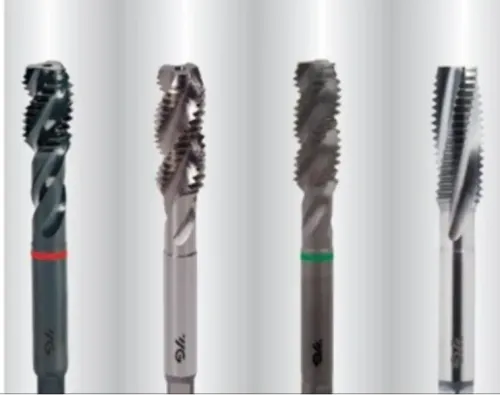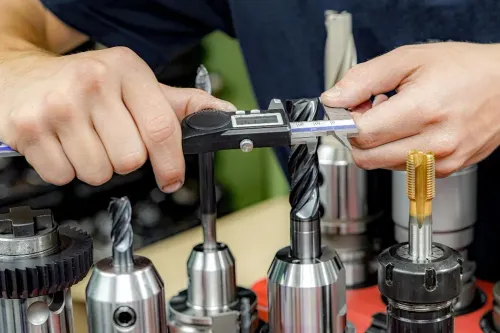
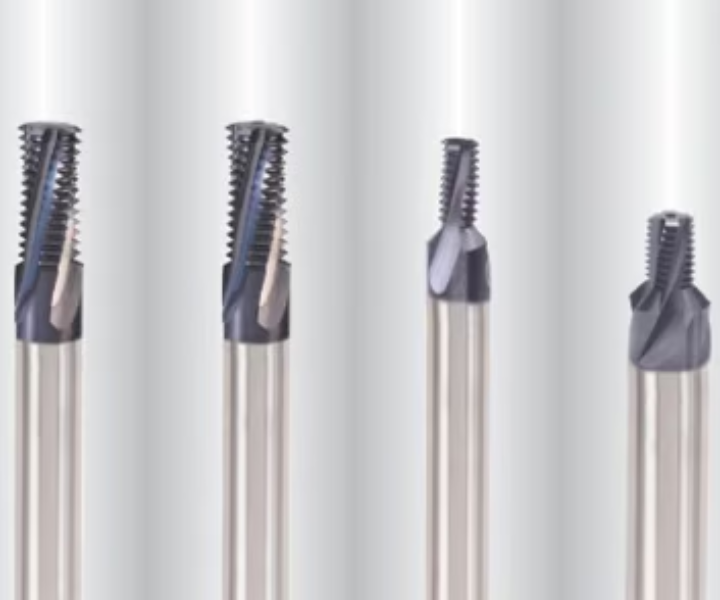
Producing an internal or external thread is not limited to conventional tapping. CNC manufacturers can also use thread mills in suitable applications, particularly when flexibility, thread control or machining strategy makes milling advantageous.
The correct choice depends on the component, machine and production requirement rather than assuming one threading method is universally superior.
How Thread Milling Works
Thread milling uses a rotating cutter that follows a programmed path to generate the thread.
Unlike a conventional tap that follows the thread axis into the hole, a thread mill relies on coordinated CNC movement.
This makes machine capability and programming important parts of the process.
Why Manufacturers Consider Thread Mills
Thread milling can offer useful flexibility in selected CNC applications.
Depending on tool design and programming strategy, advantages can include:
- Ability to control thread dimensions through programming adjustments
- Potential application across different thread requirements within the tool's capability
- Controlled chip generation
- Suitability for certain larger-diameter threads
- Ability to machine selected external as well as internal threads
These characteristics can be valuable where CNC flexibility is more important than using the simplest possible threading cycle.
Machine Capability Is Essential
Thread milling requires a CNC machine capable of producing the necessary coordinated movement accurately.
Machine condition, toolholding rigidity and programming accuracy therefore have a direct influence on results.
Before selecting a thread mill, confirm:
- Thread form
- Diameter
- Pitch
- Thread depth
- Internal or external requirement
- Workpiece material
- Machine capability
Providing this information helps avoid choosing a cutter based only on nominal thread size.
Consider Production Economics
Thread milling is not automatically the most economical option for every thread.
For straightforward high-volume threading, another method may provide a faster cycle depending on the component and machine. In applications involving expensive components, difficult materials or multiple threading requirements, thread milling may offer other process advantages.
The correct comparison should consider cycle time, tool life, component risk and setup flexibility.
Programming Needs Attention
The programmed toolpath influences final thread dimensions and cutting conditions.
Operators should avoid treating thread milling as simply another drilling cycle. Entry, interpolation and exit strategy need to suit the tool and component.
A trial component should be inspected carefully before full production begins.
Thread gauges or appropriate measurement methods can then confirm that the finished thread meets the specified requirement.
Selecting a Supplier in Delhi
When sourcing thread mills for a CNC operation, provide more information than 'M10 thread mill' or a similar brief description.
R.S. Tools & Engineers Pvt. Ltd. supplies industrial tooling solutions in Delhi, including products for machining and threading requirements. A useful enquiry should identify the thread specification, material, depth, machine and production quantity.
This allows the tooling discussion to begin with the application rather than assumptions.
When Thread Milling Is Worth Evaluating
Thread mills are particularly worth investigating when a CNC process requires greater control over thread generation, when chip management is important or when the application benefits from the flexibility of programmed thread production.
They should nevertheless be evaluated against alternative methods under actual production requirements.
A short controlled trial can establish cycle time, thread quality and tool life. That evidence allows Delhi manufacturers to decide whether thread milling offers a practical technical and commercial advantage for the component being produced.